
C and C++ remain two of the most powerful and widely used programming languages in the world. Despite being decades old, they continue to dominate fields where performance, control, and efficiency are non-negotiable. C was developed in the early 1970s by Dennis Ritchie at Bell Labs and became the foundation for many modern programming languages. C++ was created by Bjarne Stroustrup in the 1980s as an extension of C, adding object-oriented programming features while retaining C's low-level capabilities.
Whether you are a beginner taking your first steps into programming or an experienced developer looking to deepen your expertise, mastering C and C++ opens doors to some of the most exciting and high-impact areas of software development. From operating systems and embedded firmware to AAA game engines and high-frequency trading systems, C and C++ power the world's most demanding software.
When is C used? What are the applications of C++?
C is the language of choice whenever you need direct hardware access, minimal runtime overhead, and predictable performance. It is the language in which most operating system kernels, device drivers, and embedded firmware are written. C gives programmers fine-grained control over memory and system resources, making it indispensable in environments where every byte and every clock cycle matters.
C++ builds on C's strengths and adds powerful abstractions — classes, templates, the Standard Template Library (STL), and modern features introduced in C++11 through C++23. This makes C++ suitable for large-scale software systems where both performance and code organisation are critical. The applications of C and C++ span an enormous range of domains.
1. Embedded Systems Programming
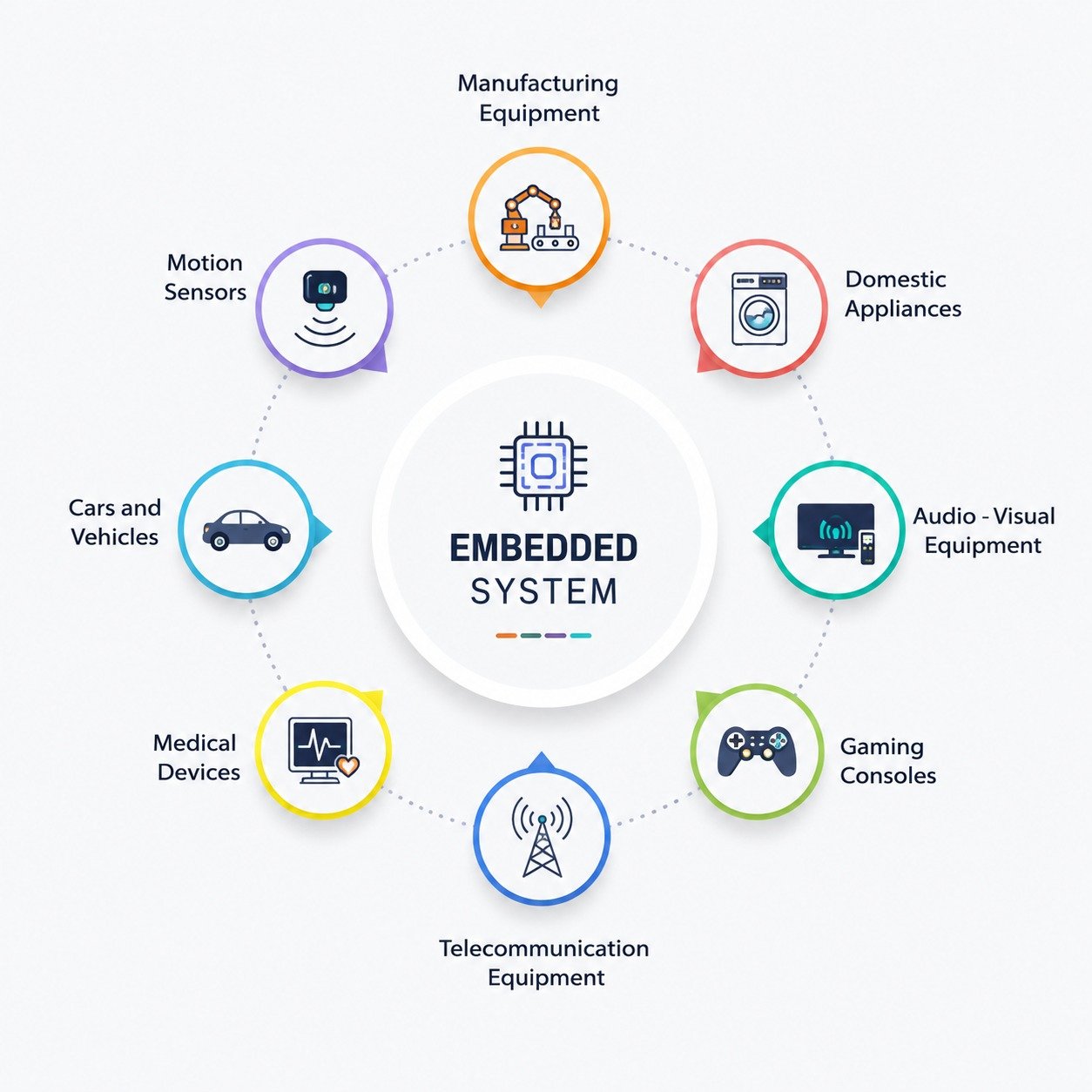
Embedded systems are specialised computing systems built into larger devices — from microwave ovens and washing machines to automotive ECUs, medical devices, and industrial controllers. C is the dominant language in this space because embedded systems typically have very limited memory and processing power, and require direct interaction with hardware registers and peripherals.
C's ability to compile to highly efficient machine code, combined with its minimal runtime requirements, makes it ideal for microcontrollers like the Arduino (AVR), ARM Cortex-M series, and PIC microcontrollers. Embedded C programming involves writing bare-metal code, working with memory-mapped I/O, handling interrupts, and managing real-time constraints — skills that are in extremely high demand across the automotive, aerospace, medical, and consumer electronics industries.
- Automotive systems: Engine control units (ECUs), ABS, airbag controllers, and infotainment systems are all written in C or C++.
- Medical devices: Pacemakers, insulin pumps, and diagnostic equipment rely on C for safety-critical, real-time operation.
- IoT devices: Smart sensors, wearables, and connected home devices use C for firmware development on resource-constrained hardware.
- Industrial automation: PLCs (Programmable Logic Controllers) and SCADA systems use C for reliable, deterministic control.
2. Game & Game Engine Development
C++ is the language of the games industry. Every major game engine — Unreal Engine, Unity (its core runtime), CryEngine, and id Tech — is written in C++. The reason is simple: games demand the absolute maximum performance from hardware, and C++ delivers it. Real-time rendering, physics simulation, AI pathfinding, and audio processing all need to run within tight frame-time budgets, often targeting 60 or 120 frames per second.
C++ gives game developers the tools to write high-performance code while still organising complex systems through object-oriented and data-oriented design patterns. Features like templates, inline functions, move semantics, and cache-friendly data structures allow game programmers to squeeze every ounce of performance from modern CPUs and GPUs.
- Unreal Engine: Epic Games' Unreal Engine is written entirely in C++ and exposes a full C++ API for game logic, allowing developers to build AAA-quality games.
- Game physics: Physics engines like Bullet and PhysX are written in C++ for maximum simulation speed.
- Graphics programming: Low-level graphics APIs like Vulkan, DirectX, and OpenGL are accessed through C and C++ for real-time rendering pipelines.
- Indie and AAA games: From small indie studios to blockbuster titles, C++ remains the standard for performance-critical game code.
3. Desktop & Cross-Platform App Development
C++ is widely used for building desktop applications that require high performance, a native look and feel, and cross-platform compatibility. Frameworks like Qt (used by VLC, Autodesk Maya, and many others) and wxWidgets allow developers to write C++ applications that run natively on Windows, macOS, and Linux from a single codebase.
Many of the most widely used desktop applications in the world are written in C++. Adobe Photoshop, Microsoft Office, Google Chrome, Mozilla Firefox, and VLC Media Player all have C++ at their core. The combination of performance, mature tooling, and extensive libraries makes C++ a strong choice for any desktop application where responsiveness and efficiency matter.
- Qt framework: A powerful cross-platform C++ framework used for GUI applications, embedded systems, and mobile development.
- Productivity software: Office suites, image editors, and video editors rely on C++ for fast processing of large files and complex operations.
- Web browsers: Chrome (V8 engine), Firefox (SpiderMonkey), and Safari (JavaScriptCore) are all built with C++ for maximum JavaScript execution speed.
- Database engines: MySQL, PostgreSQL, and SQLite are written in C for high-performance data storage and retrieval.
What are some other applications?
Beyond the three major domains above, C and C++ are used across a remarkably broad range of applications. Operating systems — including the Linux kernel, Windows NT kernel, and macOS XNU kernel — are written primarily in C. Compilers and interpreters for languages like Python, Ruby, and PHP are themselves written in C or C++. High-performance computing (HPC) applications in scientific research, weather modelling, and financial modelling rely on C++ for maximum computational throughput.
Networking infrastructure — routers, switches, and network stacks — is built in C for its speed and direct hardware access. Cryptographic libraries like OpenSSL are written in C. Even modern technologies like machine learning frameworks (TensorFlow, PyTorch) have their performance-critical kernels written in C++, with Python serving only as a high-level interface.
- Operating systems: Linux, Windows, macOS, and most real-time operating systems (RTOS) are written in C.
- Compilers and interpreters: GCC, Clang, CPython, and V8 are all implemented in C or C++.
- High-performance computing: Scientific simulations, financial modelling, and data analytics pipelines use C++ for speed.
- Networking and security: Network stacks, firewalls, VPNs, and cryptographic libraries are built in C for reliability and performance.
- Machine learning backends: TensorFlow, PyTorch, and ONNX Runtime use C++ for their core computation engines.
- Databases: MySQL, PostgreSQL, Redis, and MongoDB are all written in C or C++ for high-throughput data operations.
Share This Post
Leave a Reply
Your email address will not be published. Required fields are marked *