
React Native: Ultimate Comprehensive Guide
to Getting Started with React Native in 2024
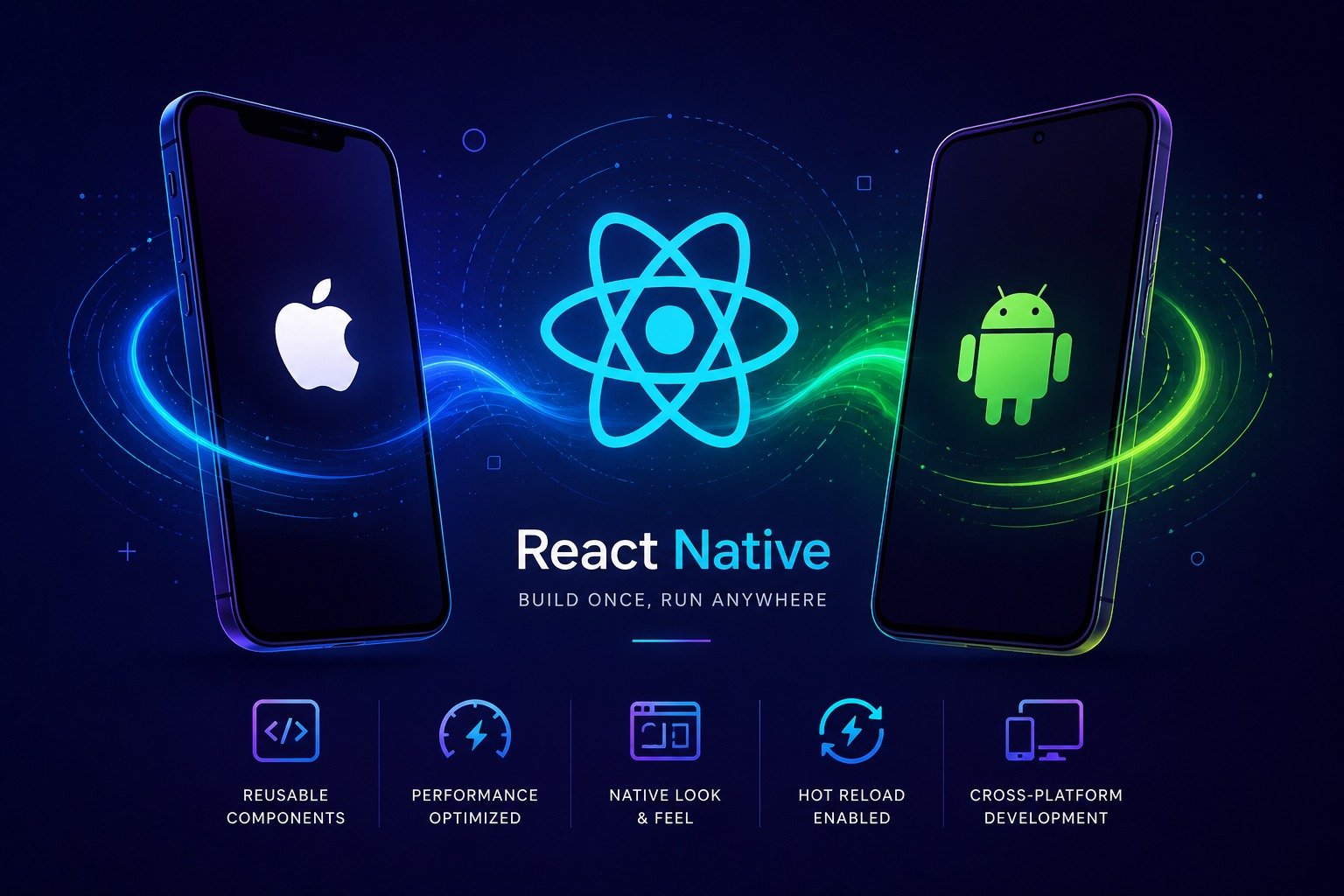
01 What is React Native?
React Native is an open-source UI software framework created by Meta Platforms, Inc. It is used to develop applications for Android, Android TV, iOS, macOS, tvOS, Web, Windows and UWP by enabling developers to use the React framework along with native platform capabilities. React Native allows developers to build mobile applications using JavaScript and React, while still rendering truly native UI components — not web views.
Unlike hybrid frameworks that wrap a web app inside a native shell, React Native compiles to actual native components. This means apps built with React Native look, feel, and perform like apps built with Swift or Kotlin. The framework bridges JavaScript code with native platform APIs, giving developers access to device features like the camera, GPS, and push notifications.
React Native was first released by Facebook as an open-source project in 2015 and has since grown into one of the most popular frameworks for cross-platform mobile development. Major companies including Instagram, Facebook, Skype, Airbnb, and Tesla have used React Native to build or enhance their mobile applications, demonstrating its production-readiness and scalability.
02 The History of React Native
- Facebook's mobile problem: Before React Native, Facebook struggled with maintaining separate native codebases for Android and iOS, which was slow and expensive.
- HTML5 limitations: Facebook initially tried building mobile apps using HTML5 inside a web view, but performance was poor and the user experience felt unnatural compared to native apps.
- Jordan Walke's innovation: Jordan Walke, the engineer who created ReactJS, began exploring how React's component model could be applied to native mobile rendering rather than the browser DOM.
- Internal hackathon: The concept of React Native was born at an internal Facebook hackathon in 2013, where engineers prototyped a way to render native UI components using JavaScript and React.
- JavaScript + native rendering: The breakthrough was using a JavaScript bridge to communicate between the JS thread and the native UI thread, allowing React components to map directly to native views.
- GitHub open-source release: Facebook open-sourced React Native on GitHub in March 2015, and it quickly gained massive community adoption, becoming one of the top repositories on the platform.
03 React JS vs. React Native
While React JS and React Native share the same core philosophy — component-based architecture, declarative UI, and a virtual DOM-like reconciliation model — they serve fundamentally different purposes and target different platforms.

ReactJS — Web
A JavaScript library for building user interfaces in web browsers. Renders HTML elements to the browser's DOM for single-page applications and dynamic websites.
React Native — Mobile
A framework for building native mobile applications. Renders native UI components on Android and iOS devices instead of HTML to a browser.
JSX Syntax
Both use JSX, but React Native uses its own core components like View, Text, and Image instead of HTML tags like div, p, and img.
Styling Differences
ReactJS uses standard HTML and CSS. React Native uses a StyleSheet API resembling CSS but implemented as JavaScript objects, with layout handled by Flexbox.
04 Cross-Platform Development
With a single JavaScript codebase, React Native developers can build applications that run natively on both Android and iOS — and increasingly on Windows and macOS — dramatically reducing development time and cost.
React Native achieves this through a set of reusable core components — such as View, Text, Image, ScrollView, and TextInput — that map to their native equivalents on each platform. When you write a View component, React Native renders a UIView on iOS and an android.view on Android. This means the app looks and behaves natively on each platform while sharing the same business logic and UI structure.
The reusable component model dramatically reduces development time and cost. Teams no longer need separate iOS and Android developers — a single React Native team can ship to both platforms simultaneously. Platform-specific code can still be written when needed using the Platform API or platform-specific file extensions (.ios.js and .android.js), giving developers full flexibility without sacrificing the benefits of code sharing.
05 Benefits of React Native
- Code Reusability — Share up to 90% of code between iOS and Android, reducing development effort significantly.
- Native Performance — Renders actual native components, not web views, delivering smooth 60fps animations and native-feel interactions.
- Hot Reloading — See changes instantly without rebuilding the entire app, dramatically speeding up the development cycle.
- Large Ecosystem — Access to thousands of npm packages and a vibrant open-source community with active maintenance.
- Cost Effective — One team, one codebase, two platforms — significantly lower development and maintenance costs compared to native development.
- Backed by Meta — Actively maintained by Meta and a large community, ensuring long-term support and regular updates.
06 Examples of Mobile Apps Built with React Native
Instagram is one of the most well-known examples of a production app built with React Native. Meta integrated React Native into the Instagram app to accelerate feature development and improve code sharing between the iOS and Android teams. The Push Notification view, the share screen, and several other key features were rebuilt using React Native, allowing the team to ship features faster without sacrificing the native look and feel.
Instagram's adoption of React Native demonstrated that the framework could handle the demands of a high-traffic, feature-rich consumer application used by over a billion people. The success helped validate the framework for enterprise-scale mobile development and encouraged many other companies to adopt it.
Facebook itself uses React Native for several parts of its mobile app. The Ads Manager app was one of the first full React Native apps shipped by Meta, and it proved that React Native could deliver a polished, high-performance experience for a complex business application.
Skype
Microsoft rebuilt Skype's mobile app using React Native, enabling a consistent experience across iOS and Android while sharing a large portion of the codebase. The rewrite improved performance and allowed the team to ship new features simultaneously on both platforms.
07 Final Thoughts
React Native has matured significantly since its 2015 release and remains one of the best choices for cross-platform mobile development in 2024. With the new architecture (JSI, Fabric, and TurboModules) rolling out, performance is closer to native than ever before.
"Learn once, write anywhere." — The React Native philosophy that changed mobile development forever.
Whether you are a web developer looking to enter mobile development or a team wanting to reduce the cost of maintaining separate iOS and Android codebases, React Native is a proven, production-ready solution. Get in touch with our team to explore how we can help you build your next mobile application.
Do follow links for more contents: React JS – 6 Essential Tips Every Beginners Should Know 2024
Share This Post
2 Responses
Pingback
September 12, 2024CYBERCRIME : How To Secure Your Data From The Latest Cyber Attacks – 2024
Pingback
September 11, 2024Top 12 Ultimate Java Features Beginners Must Know | AthenaS