
Presentation to Java
Java programming language was made by James Gosling in 1995. The unique thought was to plan a language for the industry. Java quickly worked along with this group processor called the Green Group and the primary they worked on was called Greentalk. This project was afterwards named Oak — after the oak tree that stood outside Gosling's office. This title had to be dropped afterward as it was also a title of a trademark by Oak Technologies.
So how was the title Java suggested?
Since the language team could no longer be named OAK, Gosling and his group had to come up with modern titles. But the title had to be unique and very simple to say. The title JAVA happened in Gosling's intellectual universe having a glass of coffee at his office. Java — a slang term for coffee — stuck, and the name became synonymous with one of the most widely used programming languages in the world.
The choice of name reflected the team's desire for something energetic, distinctive, and memorable. Java was officially released to the public in 1996 and quickly gained traction in the enterprise software world, particularly for web-based applications and server-side development. Its "write once, run anywhere" philosophy resonated strongly with developers who needed to build applications that could run across diverse hardware and operating system environments.
Working Stream of Java
Java type in the program in the Java programming language, at that point a compiler turns the program into a Java bytecode — the instruction set for the Java Virtual Machine (JVM) that is a portion of the Java runtime environment (JRE). Java bytecode is utilised afterward on any framework with the hardware JVM, permitting your Java code to run anywhere.
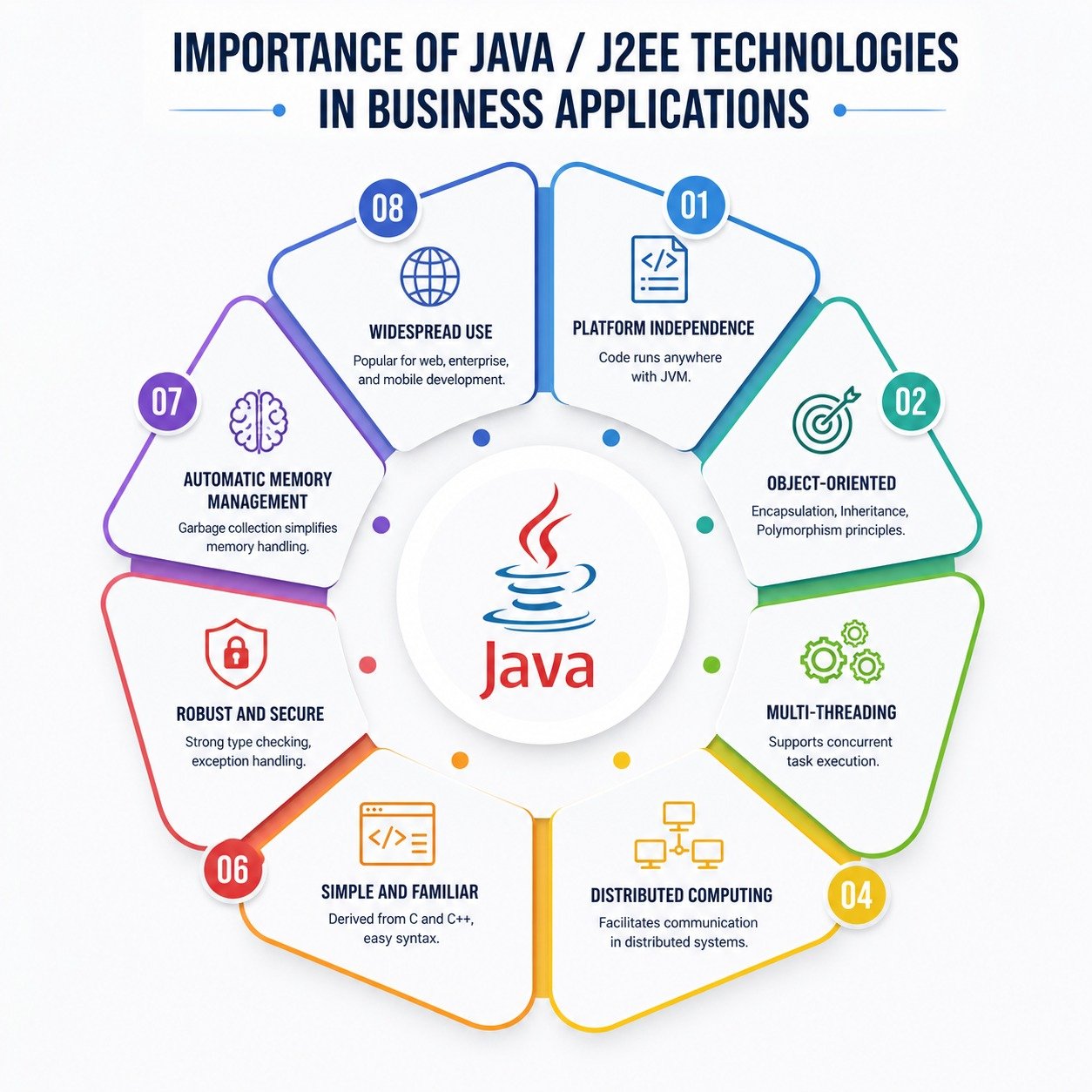
The Java program stage comprises of the JVM, the Java API and a total environment framework. The JVM parses and runs directions. The Java API comprises an imperative set of libraries that incorporate fundamental objects, organising and security capacities, Enterprise Markup Language (XML), and web administrations. Taken together, the Java Language and the Java program stage make a capable, demonstrated information framework that powers billions of devices worldwide — from enterprise servers and cloud platforms to Android smartphones and embedded systems.
Features
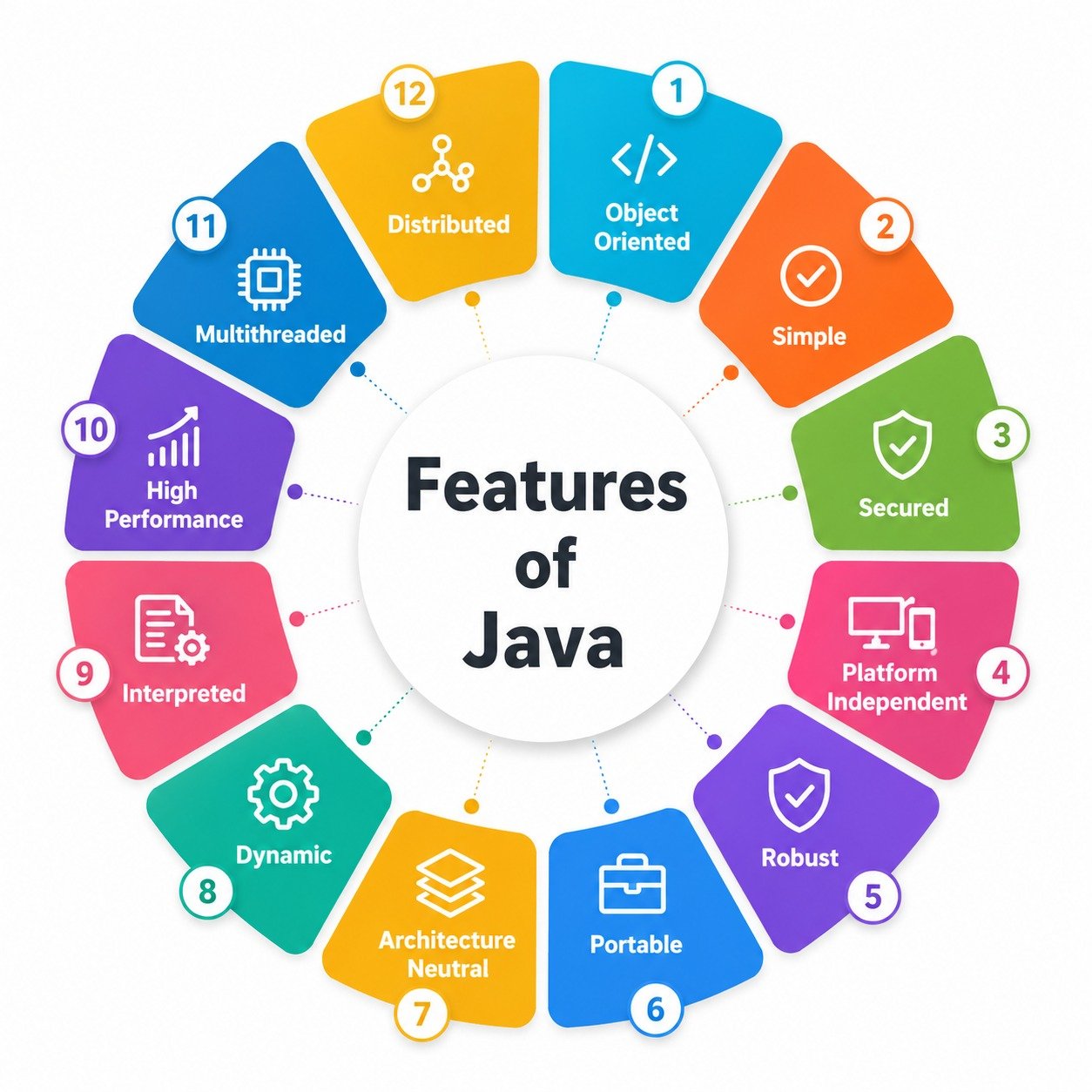
- Object-Oriented: In object-oriented programming everything is an object rather than function and logic. Java's OOP model promotes code reusability, modularity, and maintainability.
- Simple: Java is simple to understand, easy to learn and straightforward to implement. Its syntax is clean and readable, making it an ideal first language for beginners.
- Secured: It is possible to design secured program frameworks utilising Java. The language provides built-in security features including bytecode verification, a security manager, and cryptography APIs.
- Platform Independent: Java is a "write once, run anywhere" language — once the code is composed, it can be executed on any computer program and equipment system that has a JVM installed.
- Portable: Java is not essentially secured to a single equipment machine. Once made, Java code can be utilised on any platform without modification or recompilation.
- Architecture Neutral: Java is architecture impartial meaning the measure of primitive types is settled and does not vary depending upon the sort of architecture, ensuring consistent behaviour across platforms.
- Robust: Java emphasises a part on mistake checking, memory administration, and exception handling. This makes it a robust language that reduces the likelihood of system crashes.
- Interpreted: Java changes over high-level program clarification into computer-level language, hence making it interpreted. The JIT (Just-In-Time) compiler further optimises execution at runtime.
- Distributed: Java lets us make distributed applications that can run on different computers simultaneously, making it ideal for networked and cloud-based systems.
- Dynamic: Java is outlined to adjust to ever-evolving frameworks, making it dynamic. It supports dynamic loading of classes and interfaces at runtime.
- Multi-threaded: Multi-threading is an ability given by Java for making web applications and concurrent programs. Java's built-in thread support enables efficient use of multi-core processors.
- High-performance: Java employs a Just-In-Time compiler, thereby giving high overall performance. Modern JVM implementations include advanced optimisations such as adaptive compilation and garbage collection tuning.
Basic Java Syntax
It is especially vital to follow the fitting language structure whereas composing Java code, as we might get errors for the smallest mistake in our code. The class title should be the same as that of the title of the Java record. And each line of code must be composed interior a class.
package syntax;

public class test3145 {
    public static void main(String[] args) {
        System.out.println("Java program with same file name and class name");
    }
}
Output: Java program with same file name and class name
Every Java application must have at least one class definition that contains the main method — the entry point of the program. The main method signature must be exactly public static void main(String[] args). Java is case-sensitive, so Main and main are treated as different identifiers. Statements end with a semicolon, and code blocks are enclosed in curly braces. Following these conventions consistently is essential for writing clean, error-free Java code.
Business benefits
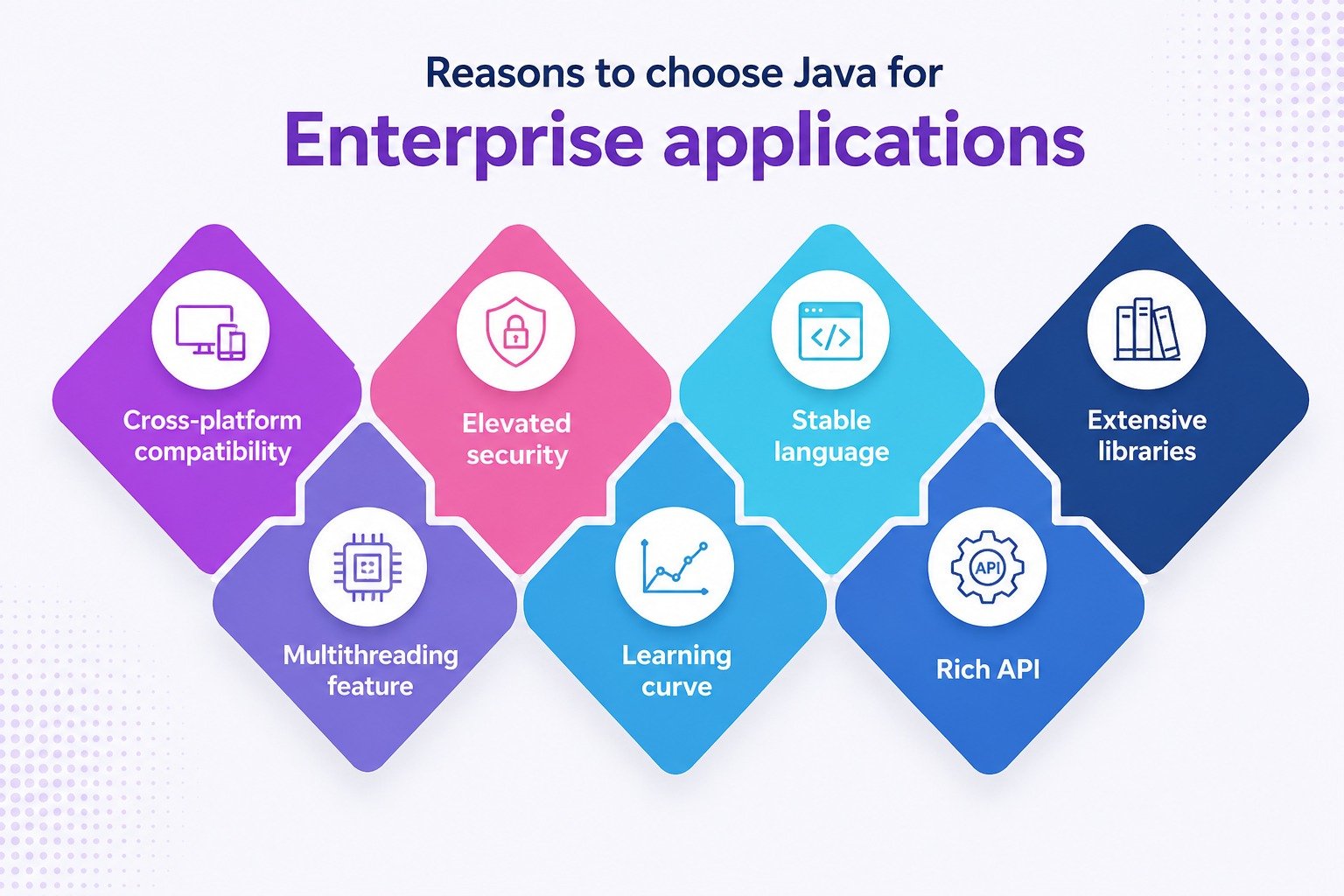
- The specialised construction for Java is compelling, but the trade reasons to select Java are similarly solid: a separate ability pool, a brief learning bend and a wide extend of coordinated improvement situations.
- The expansive ability pool of Java engineers contributes a compelling reason to base major program activities on Java. When staffing directors post work openings for Java designers, they can anticipate receiving numerous qualified resumes and fill those positions moderately quickly.
- As more companies utilise associated gadgets, machine learning calculations and cloud arrangements, the request for gifted engineers proceeds to develop. Many businesses will require strategic and service-level software engineers in the near future, making it troublesome to staff modern program activities.
- Supporters can moreover claim that contrast exists to supplement IT results staff for particular needs without including headcount, reducing overall project costs.
In expansion to specialised engineers, major program activities moreover require expansive numbers of junior supporters. Whereas Java remains a well-known basic programming language in college computer science curriculums, many graduates are quickly capable of being productive on day one. Java is simpler to learn and master than many other programming languages, driving to a shorter learning curve and quicker ramp-up to efficiency. Java's broad online community of engineer gatherings, instructional exercises and certifications makes a difference to developers cut up to speed quickly and gives program software engineers with effective demonstrated problem-solving instruments.
Do follow links for more contents: https://athenas.co.in