
Network Topologies
A network topology is the physical and logical arrangement of nodes and connections in a network. It defines how different devices — computers, servers, switches, routers, and other hardware — are interconnected and how data flows between them. Choosing the right topology is one of the most critical decisions in network design, as it directly impacts performance, scalability, fault tolerance, and security.
Network topologies can be broadly classified into two categories: physical topology, which describes the actual layout of cables and devices, and logical topology, which describes how data travels through the network regardless of its physical design. Understanding both dimensions is essential for building robust, high-performance networks.

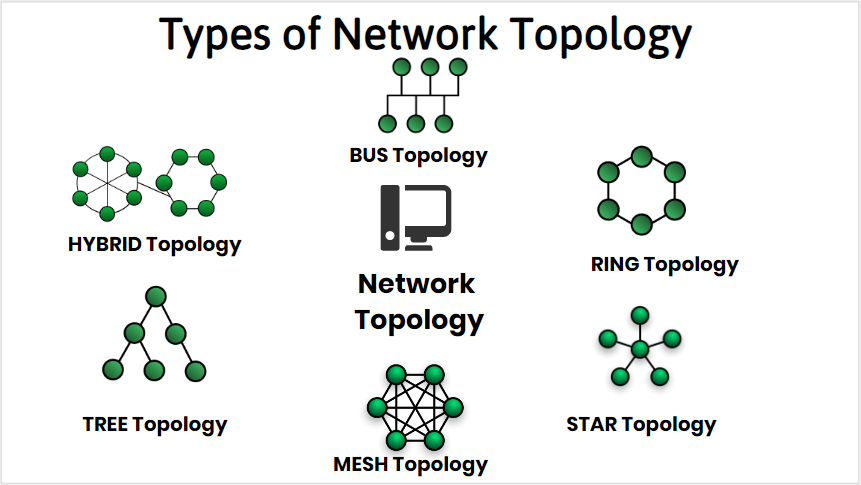
The most common network topologies include bus, star, ring, mesh, tree, and hybrid configurations. Each has distinct characteristics that make it suitable for different use cases, scales, and security requirements. Modern enterprise networks typically employ hybrid topologies that combine the strengths of multiple designs to meet complex operational demands.
Bus Topology
In a bus topology, all devices share a single communication line called the bus. Data transmitted by any device travels along the entire bus and is received by all nodes, but only the intended recipient processes it. Bus topologies are simple and inexpensive to implement but suffer from performance degradation as more devices are added and are vulnerable to single points of failure.
Star Topology
The star topology connects all devices to a central hub or switch. All communication passes through this central node, making it easy to manage and troubleshoot. If one device fails, the rest of the network remains unaffected. However, the central hub represents a single point of failure — if it goes down, the entire network is disrupted.
Ring Topology
In a ring topology, each device is connected to exactly two other devices, forming a circular data path. Data travels in one direction (or both directions in a dual-ring configuration) around the ring until it reaches its destination. Ring topologies offer predictable performance but can be disrupted by a single cable or device failure.
Mesh Topology
A mesh topology connects every device to every other device in the network. This provides maximum redundancy and fault tolerance — if any single connection fails, data can be rerouted through alternative paths. Full mesh topologies are highly reliable but expensive to implement due to the large number of connections required.
Components of networking
A computer network is built from a combination of hardware and software components that work together to enable communication and resource sharing. Understanding these components is fundamental to designing, deploying, and maintaining effective network infrastructure.
- Network Interface Cards (NICs): Hardware components installed in devices that enable them to connect to a network. Each NIC has a unique MAC address that identifies the device on the local network.
- Switches: Devices that connect multiple devices within a local area network (LAN) and use MAC addresses to forward data only to the intended recipient, improving efficiency over hubs.
- Routers: Devices that connect different networks and direct data packets between them using IP addresses. Routers are essential for connecting LANs to the internet and to other networks.
- Hubs: Basic networking devices that broadcast incoming data to all connected devices. Largely replaced by switches in modern networks due to their inefficiency.
- Firewalls: Security devices or software that monitor and control incoming and outgoing network traffic based on predefined security rules, protecting networks from unauthorized access.
- Access Points: Devices that allow wireless devices to connect to a wired network using Wi-Fi, extending network coverage without requiring physical cable connections.
- Cables and Connectors: Physical media including Ethernet cables (Cat5e, Cat6, Cat6a), fiber optic cables, and their associated connectors that carry data signals between devices.
- Network Operating Systems: Software that manages network resources, controls access, and provides services such as file sharing, print management, and user authentication.
Links
Network links are the communication pathways that connect nodes in a network. The type, quality, and capacity of these links fundamentally determine the performance characteristics of the network. Links can be wired or wireless, and each type has distinct advantages and limitations.
Wired links using copper cables such as twisted pair Ethernet provide reliable, high-speed connections suitable for most office and data center environments. Fiber optic links offer significantly higher bandwidth and longer transmission distances, making them ideal for backbone connections and high-demand applications. Wireless links provide flexibility and mobility but are subject to interference, signal degradation, and security vulnerabilities that require careful management.
- Bandwidth: The maximum data transfer rate of a link, typically measured in Mbps or Gbps. Higher bandwidth links support more simultaneous users and data-intensive applications.
- Latency: The time delay for data to travel from source to destination. Low latency is critical for real-time applications such as video conferencing, VoIP, and online gaming.
- Reliability: The consistency and uptime of a link. Redundant links and failover mechanisms ensure network availability even when individual connections fail.
- Security: The degree to which a link is protected from eavesdropping, interception, and unauthorized access. Encryption protocols such as TLS and VPNs are commonly used to secure data in transit.
Communication
Network communication is the process by which data is transmitted between devices across a network. It relies on a layered set of protocols and standards that govern how data is formatted, addressed, transmitted, routed, and received. The most widely used framework for understanding network communication is the OSI (Open Systems Interconnection) model, which divides the communication process into seven distinct layers.
Effective network communication depends on the correct implementation of protocols at each layer of the stack. The TCP/IP protocol suite, which underpins the internet and most modern networks, provides a robust and flexible framework for reliable data transmission across diverse network environments.
Key Communication Protocols
Several protocols govern different aspects of network communication, each serving a specific purpose within the overall communication framework:
- TCP (Transmission Control Protocol): Provides reliable, ordered, and error-checked delivery of data between applications. Used for web browsing, email, and file transfers where data integrity is critical.
- UDP (User Datagram Protocol): A connectionless protocol that prioritizes speed over reliability. Used for streaming media, online gaming, and DNS lookups where some data loss is acceptable.
- HTTP/HTTPS: The foundation of data communication on the World Wide Web. HTTPS adds encryption via TLS to protect data in transit.
- DNS (Domain Name System): Translates human-readable domain names into IP addresses, enabling users to access websites using memorable names rather than numeric addresses.
- DHCP (Dynamic Host Configuration Protocol): Automatically assigns IP addresses and other network configuration parameters to devices, simplifying network administration.
Advantages of computer networks
Computer networks provide a wide range of benefits that have transformed the way organizations operate and individuals communicate. From enabling resource sharing to supporting global collaboration, the advantages of networking are fundamental to modern digital life.
- Resource sharing: Networks allow multiple users to share hardware resources such as printers, scanners, and storage devices, reducing costs and improving efficiency.
- Data sharing and collaboration: Networks enable teams to share files, databases, and applications in real time, supporting collaboration across locations and time zones.
- Centralized data management: Storing data on centralized servers makes it easier to back up, secure, and manage, reducing the risk of data loss and ensuring consistency.
- Communication: Networks support email, instant messaging, video conferencing, and VoIP, enabling fast and cost-effective communication within and between organizations.
- Internet access: Networks provide the infrastructure for connecting devices to the internet, enabling access to a vast range of information, services, and applications.
- Scalability: Well-designed networks can be easily expanded to accommodate growth, adding new devices and users without disrupting existing operations.
- Cost efficiency: By sharing resources and centralizing management, networks reduce the total cost of ownership for IT infrastructure.
- Enhanced security: Centralized security management, including firewalls, intrusion detection systems, and access controls, provides stronger protection than individual device security.
The future of networking
The networking landscape is evolving rapidly, driven by advances in technology and the growing demands of digital transformation. Several key trends are shaping the future of networking and will define how organizations design and manage their network infrastructure in the coming years.
Software-Defined Networking (SDN) is decoupling the network control plane from the data plane, enabling more flexible, programmable, and centrally managed networks. This approach allows organizations to respond more quickly to changing business needs and to automate network management tasks that previously required manual intervention.
The proliferation of Internet of Things (IoT) devices is creating new demands on network infrastructure, requiring networks to support massive numbers of connected devices with diverse communication requirements. Edge computing is emerging as a complementary approach, processing data closer to where it is generated to reduce latency and bandwidth consumption.
- 5G and beyond: Next-generation wireless networks will deliver dramatically higher speeds, lower latency, and greater capacity, enabling new applications in areas such as autonomous vehicles, smart cities, and industrial automation.
- Network automation: AI and machine learning are being applied to network management, enabling automated configuration, fault detection, and performance optimization.
- Zero Trust Security: The traditional perimeter-based security model is giving way to Zero Trust architectures that verify every user and device regardless of location, providing stronger protection in an era of remote work and cloud computing.
- Intent-Based Networking (IBN): Systems that translate high-level business intent into network configurations automatically, reducing complexity and the risk of human error.
- Quantum networking: Emerging research into quantum communication promises theoretically unbreakable encryption and new capabilities for secure data transmission.
As networks continue to evolve, organizations that invest in understanding and adopting these emerging technologies will be better positioned to compete in an increasingly connected world. The foundation of any successful digital strategy is a robust, secure, and high-performance network — and the choices made today about topology, components, and protocols will shape organizational capability for years to come.
AthenaS Reader
September 5, 2024Very comprehensive overview of network topologies! The breakdown of each topology type and the future networking trends section are especially useful for anyone planning enterprise infrastructure upgrades.