
The Great Debate 2024: Solar Power vs Wind Energy
Which Is More Efficient?

01 Introduction
Solar energy is directly focused from the sun in PV panels. When photons from sunlight hit the silicon cells in a solar panel, they knock electrons loose, generating a direct current (DC) that an inverter converts to alternating current (AC) for home or grid use.
Wind energy harnesses the kinetic energy of moving air. Wind turbines capture this energy through rotating blades connected to a generator. Both technologies are proven, scalable, and increasingly cost-competitive — but they differ significantly in efficiency, land use, consistency, and application.
Understanding these differences is essential for governments, businesses, and households deciding where to invest in clean energy infrastructure in 2024 and beyond.
02 Is Solar Energy Overtaking Wind Power?
Solar energy capacity has grown at a remarkable pace over the last decade. Falling panel costs, simpler installation, and the ability to deploy solar at virtually any scale — from rooftop to utility — have made it the fastest-growing renewable source globally. In 2023, solar additions outpaced wind for the first time in many major markets.
However, wind power still holds advantages in regions with strong, consistent wind resources. Offshore wind in particular is expanding rapidly, with turbines now capable of generating power equivalent to small power stations.
The two technologies are increasingly seen as complementary rather than competing — a balanced grid often needs both solar and wind working together.
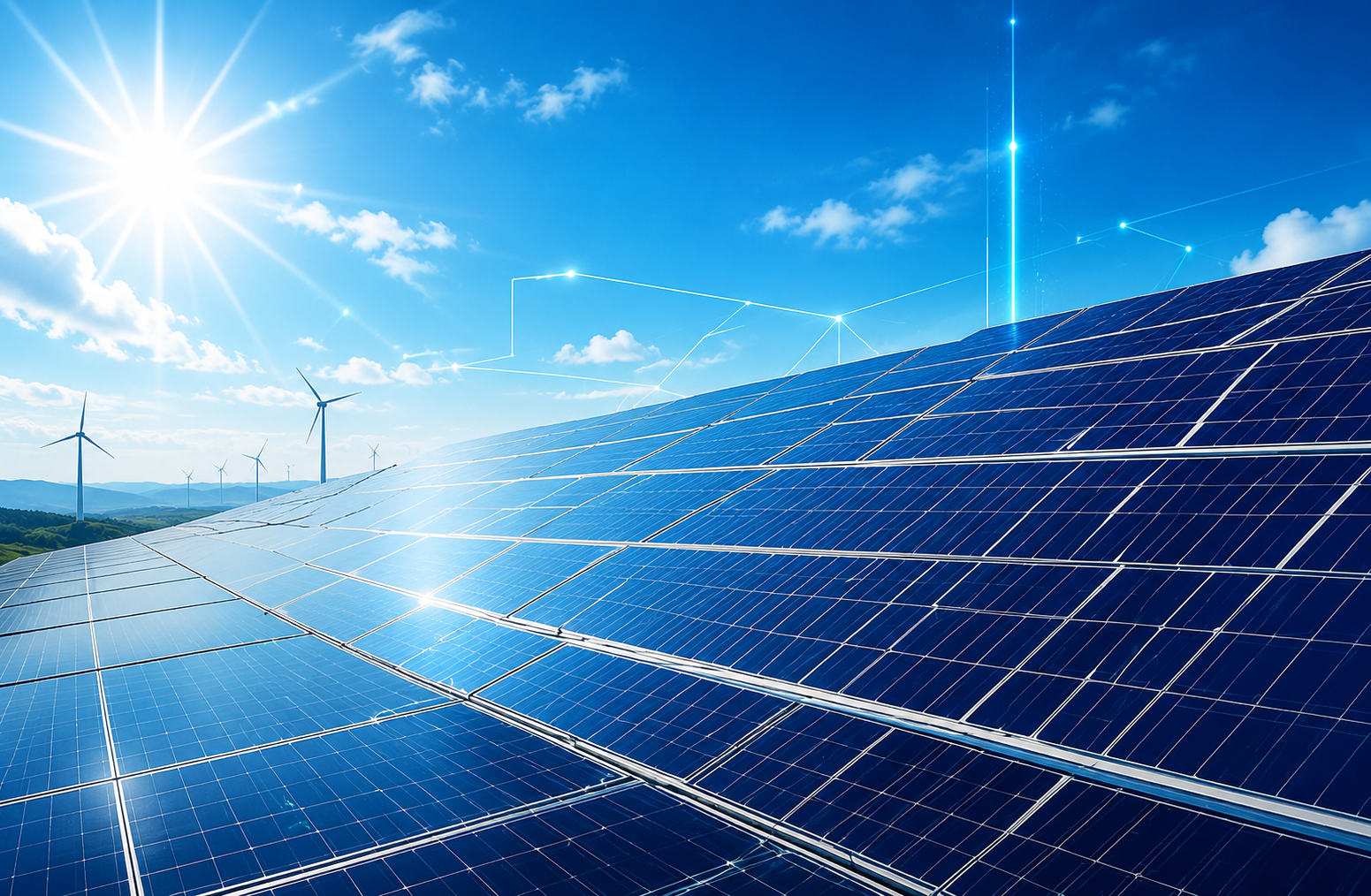
03 Head-to-Head: Key Differences
Here is a quick overview of how solar and wind compare across the most critical dimensions:
Solar Power
15–22% panel efficiency. No moving parts, low maintenance. Best in sunny regions. Highly scalable from 1 kW to 1 GW+. ~20–50 g CO₂/kWh lifecycle.
Wind Power
35–45% turbine efficiency. Moving parts need servicing. Best in coastal and open plains. Utility-scale focus. ~7–15 g CO₂/kWh lifecycle — lower overall.
04 Comparing Solar Power vs Wind Power
The table below provides a side-by-side comparison across the most important technical, economic, and environmental dimensions.
| Factor | Solar Power | Wind Power |
|---|---|---|
| Source | Sunlight (photovoltaic or thermal) | Kinetic energy of moving air |
| Technology | PV panels, solar inverters, tracking systems | Wind turbines, gearboxes, generators |
| Efficiency | 15–22% (commercial); up to 46% (lab) | 35–45% (modern turbines); Betz limit ~59% |
| Space Required | Moderate — rooftop or ground-mounted arrays | Large — turbines need spacing; land can be dual-use |
| Energy Consistency | Intermittent — dependent on daylight & weather | Intermittent — dependent on wind speed & direction |
| Location | Best in sunny, low-cloud regions; works globally | Best in coastal, open plains, and offshore areas |
| Environmental Impact | Minimal noise; some land use; glare possible | Noise, visual impact, bird/bat risk near turbines |
| Installation Cost | $1–$3 per watt (utility scale, 2024) | $1.2–$2 per watt onshore; higher offshore |
| Maintenance | Low — no moving parts; panel cleaning required | Moderate — moving parts require regular servicing |
| Lifespan | 25–30 years (panels); inverters 10–15 years | 20–25 years (turbines); blades 15–20 years |
| Scalability | Highly scalable — from 1 kW to 1 GW+ | Scalable — best at utility scale |
| Energy Storage | Pairs well with battery storage (lithium-ion) | Pairs with pumped hydro or large-scale batteries |
| Carbon Footprint | ~20–50 g CO₂/kWh (lifecycle) | ~7–15 g CO₂/kWh (lifecycle) — lower overall |
| Examples of Use | Rooftop homes, solar farms, off-grid systems | Wind farms, offshore projects, rural electrification |
05 Advantages of Solar Energy over Wind Power
Solar energy offers several practical advantages that have driven its rapid adoption worldwide:
- Location Flexibility — Solar panels can be installed almost anywhere — rooftops, parking canopies, brownfield land, and even floating on water — far more flexible than wind turbines which require specific wind corridors.
- No Moving Parts — Solar systems have no mechanical wear, quieter operation, and reduced maintenance costs. A well-maintained array can operate reliably for 25–30 years with minimal intervention.
- Dramatic Cost Reduction — The cost of solar has fallen by more than 90% since 2010, making it the cheapest source of new electricity generation in history according to the IEA.
- Battery Storage Integration — Solar integrates naturally with battery storage systems, enabling households and businesses to store daytime generation for use at night or during cloudy periods.
- Community-Friendly — Solar generates no noise, no shadow flicker, and poses no direct risk to birds or bats — making it easier to site near communities and in sensitive ecological areas.

06 Conclusion
Both solar and wind energy are essential pillars of the global clean energy transition. Wind holds an edge in raw lifecycle carbon footprint and can generate power at night, while solar leads in flexibility, cost reduction, and ease of deployment at all scales.
The most effective energy strategies in 2024 combine both technologies — using solar for distributed and rooftop generation and wind for large-scale grid supply — backed by storage and smart grid management.
"Rather than declaring a winner, the real answer is that solar and wind are stronger together — the future of renewable energy depends on deploying both intelligently."
At AthenaS Business Solutions, we help businesses navigate the renewable energy landscape and make informed, sustainable decisions. Get in touch with our team to explore the right energy strategy for you.